VectorVest Stock Advisory
- 4.5
- Rating
- 500.00K
- Installs
- Free
- Price

 Analysis by App-foxy
I approached VectorVest Stock Advisory as a finance app for the moments when a stock watchlist becomes too difficult to manage by memory alone. Its purpose is to help me examine individual shares from a mobile device, rather than relying only on headlines, casual tips, or a desktop screen. That makes it interesting for a household where more than one person follows investments, but it also means that expectations need to be realistic: this is a stock-analysis tool, not a shared family budget, a banking app, or a substitute for personal financial judgement.
The app comes from VectorVest, Inc., and it is available free of charge as an Android app for users whose device runs Android 6.0 or later. Its age classification is Everyone, which makes it straightforward to consider on a shared device from an access perspective. However, an Everyone label does not mean every user will understand the financial consequences of acting on market information. In my view, the important question is not simply whether a child or another household member can open the app, but whether the person using it understands that analysis is not the same as a guaranteed outcome.
Using the app when a household follows the same market
A realistic shared-use situation might look like this: one person in the home reads financial news during breakfast, another checks a few companies during a commute, and both want to discuss the same stocks later. A mobile stock-analysis app can make those conversations more concrete. Instead of saying that a company “looks good,” one person can open the relevant stock view and explain which signals or figures influenced that opinion.
You May Also Like

 Blood Strike: 2.5 Anniversary
Blood Strike’s Loadouts Turn Every Drop Into a Tactical Gamble
A close look at Blood Strike’s custom loadouts: how fast access to signature weapons reshapes its battle royale rhythm, rewards preparation, and narrows the gap between fights.

 Pandora - Music & Podcasts
Pandora’s Music Is Easy to Start, but Harder to Recover
Pandora’s strength is its low-effort path from a seed to a station. Its weak spot is how much confidence it asks you to place in connection, setup, and quiet recovery.

 8 Ball Pool
 Is Built on Rivalries, Rematches, and Routine
A close look at the rivalries, rematches, shared routines, and unanswered safety questions that turn a quick pool match into a persistent mobile community.

 Samsung Music
’s Quiet Strength Is Playing What You Already Own
Its reach comes less from spectacle than from dependable access to a personal library. That simplicity is both the app’s strongest retention engine and its ceiling.

 AccuWeather: Weather Radar
AccuWeather Review: A Quick, Clear Forecast for Everyday Decisions
For everyday plans, the best forecast is the one you can understand quickly. AccuWeather makes rain timing, radar, and local conditions easy to act on, with a few trade-offs.

 Hill Climb Racing
Why Hill Climb Racing Still Turns Crashes Into One More Run
A tiny car, a bumpy hill and one more upgrade: Hill Climb Racing keeps resurfacing because its simple chaos makes every near-miss feel personal.
More From Our News Desk



That is where the app’s central promise is useful. I can use it to analyze a stock when I am away from a computer, which suits quick checks before a conversation or while reviewing a personal watchlist. The convenience is not just about portability. A phone encourages shorter, more focused sessions: I can investigate one company, note what caught my attention, and close the app before turning a brief check into an unplanned hour of market browsing.
For shared use, I would establish a simple household rule: the app is for research and discussion, while any trade or account decision belongs to the person responsible for that investment account. This distinction matters because a shared phone can blur responsibility. Someone may open a stock page out of curiosity, another person may interpret that interest as a recommendation, and a third person may act without understanding the original context.
The app works best when it supports a conversation rather than replacing one. If two adults are comparing companies, I would ask each person to explain what they noticed and what they still do not understand. That process exposes a useful trade-off: a compact mobile view can make analysis approachable, but it can also leave less room for the wider context that an experienced investor normally considers.
What I would do before handing over a shared device
I would begin by deciding whose financial research is being stored or displayed on the phone. The app is free to install, but it also includes in-app purchases ranging from under five dollars to several hundred dollars per item. That price range is important in a household, particularly when a device is used by several people or when payment details are already associated with the app store. I would not let a younger or inexperienced user explore purchasing screens without an adult explaining what a purchase means.
This is not a criticism of the analysis itself; it is a practical boundary around a finance application. A free download can still lead to paid options, and the difference between installing an app and committing money inside it should be clear to everyone using the device. I would also avoid treating the free entry point as proof that the complete experience costs nothing.
On a personal phone, I would first spend time learning the layout before showing it to someone else. That gives me a chance to distinguish the information I find genuinely useful from the parts that may look authoritative simply because they are presented neatly. On a shared device, I would keep the conversation focused on interpretation: what does a signal mean, what assumptions are behind it, and what information would make the conclusion less convincing?
Another sensible boundary is to separate research time from transaction time. I would not open the app while someone is rushing to make a decision, and I would not encourage a family member to treat a quick result as an instruction to buy or sell. The mobile format makes immediate action feel easy, but good investing often benefits from slowing down.
Coordinating watchlists and opinions without mixing responsibility
The app is most helpful for coordination when everyone agrees on the question being asked. “Should we buy this?” is too broad for a short mobile session. A better question might be, “What does this company’s current analysis suggest, and what would we need to investigate before making a decision?” That wording keeps the app in its proper role and makes it easier for people with different experience levels to participate.
I would also encourage each adult to keep personal notes outside the app about why a stock was interesting at a particular moment. A shared discussion can become confusing when one person remembers a positive detail but forgets the concern that originally accompanied it. Writing down the reason for research, the date of the conversation, and the unresolved questions creates a record of thinking rather than a simple list of names.
One non-obvious advantage of this approach is that it reveals disagreement early. If two people look at the same stock and reach different conclusions, that is not automatically a failure. It may show that they have different time horizons or different tolerance for risk. The app can provide a common starting point, but it cannot decide which household priority matters more.
I would be careful about sharing conclusions with relatives who are not participating in the research. A casual message such as “this stock looks strong” can travel without the surrounding explanation. If the app is used in a family chat, I would describe it as one input among several and include the reason for looking at the stock, not just the conclusion. That small habit reduces the chance that a research observation turns into an accidental recommendation.
For someone who normally uses a basic finance news app, this service may feel more analytical and structured. A news reader is often better for discovering events, company announcements, and broad market themes. A brokerage app is usually the natural place to view holdings and place orders. VectorVest Stock Advisory sits closer to the research side of that process. I would use a news source for context, this app for stock analysis, and a regulated brokerage account for any transaction rather than expecting one mobile tool to do everything.
Age, trust, and the meaning of an Everyone rating
The Everyone content rating makes the app broadly accessible, but finance requires a more careful age conversation than entertainment apps do. A teenager may be perfectly capable of learning what a stock is and why people compare companies. That does not mean the teenager should be responsible for interpreting every signal or deciding how household money is used.
I would present the app to a younger user as an educational window into how investors organize questions. I would ask them to identify the company, describe what the analysis appears to emphasize, and list what they would want to verify elsewhere. I would not frame a favorable-looking result as a prediction. This distinction builds healthier habits than simply showing a number and asking whether it looks high or low.
Trust also matters between adults. If one person in a household is more financially experienced, the app can unintentionally give that person extra authority in a discussion. The interface may make an opinion appear more objective, even though the final decision still involves assumptions and personal circumstances. I would make room for the less experienced person to ask basic questions without treating the app’s presentation as the final word.
There is another boundary I consider important: access to the device is not the same as access to investment accounts. I would never assume that because someone can inspect stock research, they should also be able to use a brokerage account or payment method. Keeping those responsibilities separate protects both the household and the person learning about markets.
For older relatives who prefer a simple financial-news feed, this app may require more patience. The benefit is a more deliberate research process; the cost is that the user must learn how to interpret the information rather than merely read a headline. I would recommend sitting together for the first session and discussing one company slowly. If the person wants only portfolio balances or transaction history, a brokerage app will probably be a better fit.
How I judge the mobile experience in everyday use
The strongest use case is a focused stock check. Imagine that I hear a company mentioned in a conversation and want to investigate it before forming an opinion. I can open the app, search for the stock, examine the available analysis, and write down the questions that remain. The useful outcome is not necessarily a decision. It may simply be knowing whether the company deserves deeper research.
I would avoid using it as a constant-alert companion. Frequent checking can create the illusion of control, especially when markets move quickly. A phone makes it easy to revisit the same stock repeatedly, but repeated viewing does not automatically improve the quality of a decision. I prefer setting a purpose for each session: researching a new company, reviewing an existing idea, or preparing for a household discussion.
The current version is 1.33.72301, and the app has been available since August 4, 2017. Those details suggest a product with a longer presence than a brand-new experiment, while the version information is also useful when troubleshooting or discussing compatibility. On a supported Android phone, the minimum operating-system requirement is Android 6.0, so people using older hardware should check the device before planning a shared setup.
The app has an average rating of 4.5 from around 2.6 thousand ratings, with more than six hundred written reviews. It has also passed half a million installs. I see those figures as signs that many people have found the app worth trying, not as proof that it will suit every investor. Ratings cannot tell me whether the workflow matches a beginner’s needs, a household’s boundaries, or a particular investing style.
One practical weakness is the risk of overconfidence. A specialized stock-analysis app can feel more decisive than a general-purpose finance app, and that confidence may be helpful when organizing research but dangerous when it discourages independent checking. I would compare the app’s view with company information, broader market context, and my own financial plan before acting.
Another limitation is that mobile analysis has less room for side-by-side thinking than a full desktop workflow. If I am comparing several companies, tracking a long list of assumptions, or reviewing a complicated investment thesis, a larger screen and a spreadsheet may be more comfortable. The phone version is valuable for access and continuity, but I would not force it to replace every research method.
Who should use it, and who should choose something else
I would recommend trying it to an investor who wants more structure than a news feed provides and who is comfortable treating analysis as a starting point. It can also suit a household where two adults want to discuss stocks using the same research tool, provided they keep personal responsibility and account access separate.
It is less suitable for someone seeking only simple market headlines, automatic budgeting, or an easy way to manage everyday spending. It is also not my first choice for a person who wants a complete trading environment in one place. In that situation, a brokerage application may be more practical because the user’s priority is portfolio management and execution rather than stock research.
Beginners should not skip it automatically, but they should approach it with a learning plan. I would start with one familiar company, define basic terms, and compare the app’s analysis with other information. If the user cannot explain what a result means or why it matters, the correct next step is more learning, not a purchase.
Experienced investors may appreciate the convenience but still prefer a desktop platform for detailed comparisons. For them, the app’s value is likely to be mobility: checking a stock while away from the main workstation, preparing a question, or continuing research during a short break. That is a narrower role, but a useful one.
My household verdict
After considering both individual and shared use, I see VectorVest Stock Advisory as a focused mobile research companion rather than a complete household finance center. Its free installation, broad age classification, and Android compatibility make it easy to introduce, while the paid in-app options mean I would set clear purchasing boundaries before placing it on a shared device.
My favorite way to use it would be deliberately: choose one stock, inspect the analysis, record what I understand, identify what needs checking, and discuss the result without turning it into a command. That workflow makes the app more valuable than a quick glance at a headline and less risky than treating a polished screen as a promise.
The key lesson is to share the research, not the responsibility. Adults can coordinate questions and compare opinions, younger users can learn the vocabulary of investing, and each person can keep financial decisions within the appropriate account boundaries. Used that way, the app earns a place on my phone for stock investigation. Used as a shortcut to certainty or as a replacement for a brokerage and a broader financial plan, it is not the right tool.
Overall, I would recommend giving it a careful trial if you want mobile stock analysis and are willing to think critically about the results. I would keep a news source for events, a brokerage app for transactions, and personal notes for decisions. That combination respects what this app does well while avoiding the mistake of asking it to manage every part of investing.
FAQs for VectorVest Stock Advisory
01What is VectorVest Stock Advisory, and what does it offer?
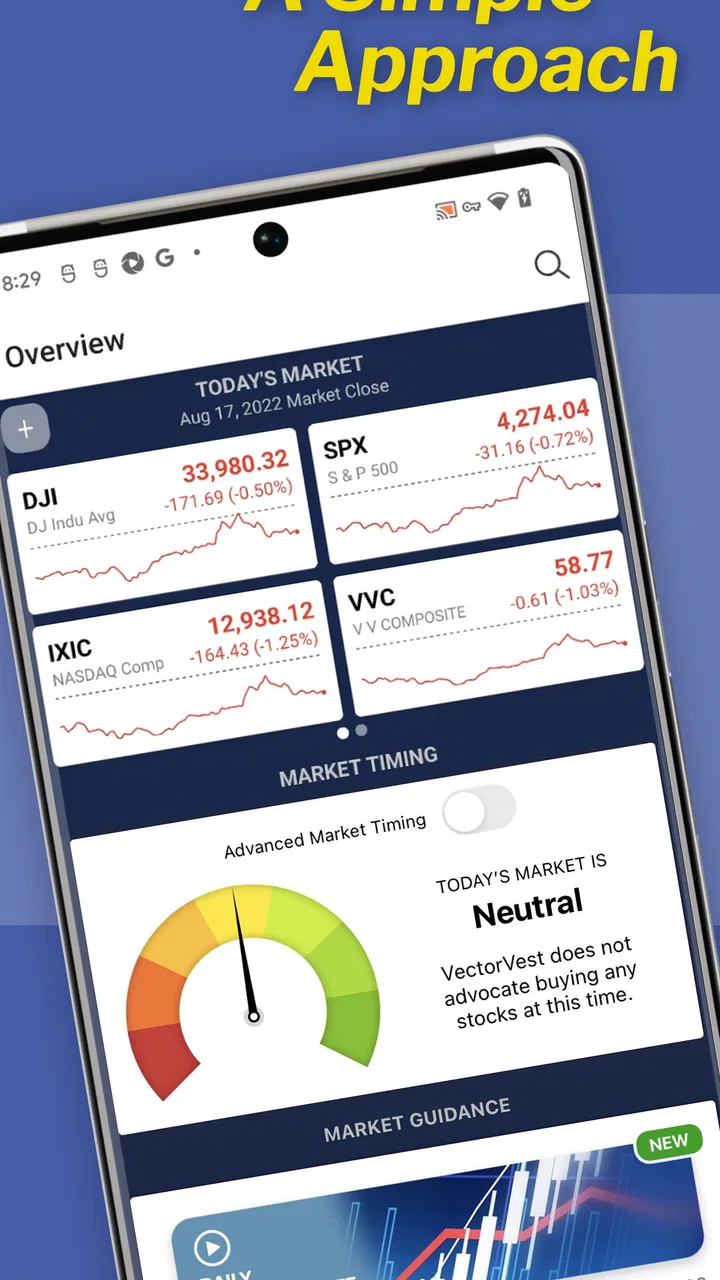
VectorVest Stock Advisory is an investment research and stock-analysis service designed to help users evaluate shares, market conditions, and potential trading opportunities. It typically combines proprietary ratings, market timing indicators, stock screening tools, watchlists, portfolio guidance, and educational content. The service is aimed at investors who want structured research rather than relying only on headlines or basic price charts.
02Is VectorVest Stock Advisory suitable for beginners?
The platform can be useful for beginners because it organizes a large amount of market information into ratings, rankings, charts, and explanations. However, new investors may need time to understand terms such as relative value, relative safety, market timing, and technical signals. It should be treated as a learning and research tool, not as a substitute for financial education or independent decision-making.
03Does VectorVest Stock Advisory provide guaranteed stock picks or investment returns?
No stock advisory service can guarantee profits, and VectorVest should not be viewed as a promise of successful trades. Its ratings, forecasts, and recommendations are based on analytical models and historical or current market data, all of which can be wrong or become outdated. Market prices can change rapidly, so users should verify information, consider their risk tolerance, and avoid investing money they cannot afford to lose.
04Does VectorVest Stock Advisory require a subscription or payment?
Access to VectorVest’s full research tools, advisory content, market analysis, and portfolio features generally depends on the plan selected and may require a paid subscription. Some versions, promotions, or introductory offers may provide limited access before payment, but terms can vary. Before downloading or subscribing, users should review the current pricing, renewal conditions, trial period, cancellation policy, and exactly which features are included.
05What should I check before using VectorVest Stock Advisory to make investment decisions?
Before acting on information from VectorVest, check whether the service fits your investment goals, experience level, time horizon, and tolerance for loss. Compare its analysis with company filings, reputable financial news, and other research sources. Also confirm that you understand any subscription charges and data limitations. The app or service can support research, but final investment decisions remain the user’s responsibility.
Pros
- Clear stock ratings help simplify buy
- hold
- and sell decisions.
- Includes market timing tools for tracking overall market conditions.
- Portfolio monitoring makes it easier to review multiple holdings.
- Offers watchlists for following potential investment opportunities.
- Educational resources can help users understand technical indicators.
Cons
- Subscription pricing may be expensive for casual or beginner investors.
- Some recommendations may feel overwhelming without investing experience.
- Data and alerts can vary depending on the selected membership plan.
- The app does not guarantee profits or protect users from market losses.
- Frequent notifications may become distracting for active watchlist users.

VectorVest Stock Advisory
Gallery